
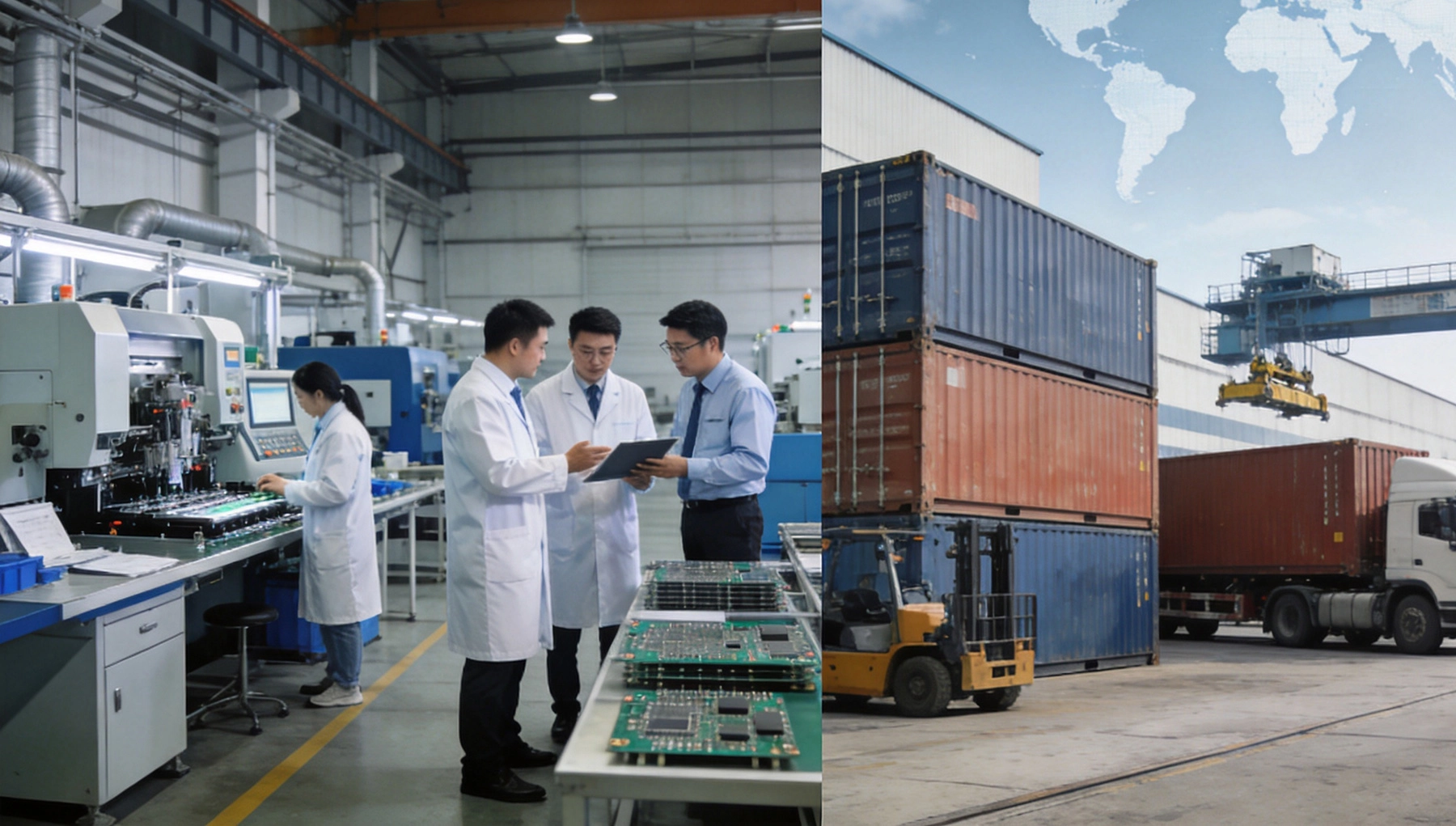
The question of where to manufacture your PCBs isn't simple anymore. A decade ago, the answer was almost automatic: overseas, because the cost savings were overwhelming. Today, the calculation is more nuanced. Local manufacturing has improved in capability and competitiveness. Overseas manufacturing has become more complex to manage. And the factors that matter most—cost, speed, quality, communication, risk—don't all point in the same direction.
This article examines the genuine advantages of each approach, without pretending that one is universally better. The right choice depends on what you're building, how much of it you need, when you need it, and what risks you can tolerate. Understanding the real trade-offs—not the assumptions—leads to better decisions.
First, let's be clear about terms. "Local" typically means manufacturing in the same country or region as your engineering team. For a US-based company, that means domestic US fabrication and assembly. For a European company, it means within Europe. The key attribute is geographic proximity that enables direct interaction, same-time-zone communication, and short shipping distances.
"Overseas" most commonly refers to manufacturing in Asia—primarily China, but also Taiwan, Vietnam, and other countries with established Electronics Manufacturing ecosystems. The key attributes are cost advantage at volume, mature supply chains, and manufacturing capacity that scales readily.
Some companies also consider "nearshore" options—manufacturing in Mexico for US teams, or Eastern Europe for Western European teams. These represent a middle ground that captures some advantages of both local and overseas approaches. The principles discussed here apply to nearshore as well, with the specific trade-offs adjusted for the geography involved.
The most cited advantage of local manufacturing is communication ease, and it's real. When your engineering team and your manufacturer operate in the same time zone, questions get answered the same day. Design reviews happen in real time. Problems get discussed while both parties are in the office, not through asynchronous email chains that add 24 hours per exchange.
This communication advantage compounds during development, when design changes are frequent and quick feedback is valuable. A Dfm issue discovered during a local manufacturer's review can be resolved in a phone call. The same issue with an overseas partner might require days of email exchange, simply because of time zone separation and language barriers that slow mutual understanding.
For complex designs—multilayer HDI boards, rigid-flex constructions, high-frequency layouts—the communication advantage matters more. These designs generate more questions, require more nuanced discussion, and benefit more from direct interaction. Simple two-layer boards with standard components generate fewer misunderstandings regardless of geography.
Local manufacturing eliminates international shipping time. A board that ships from a domestic facility arrives in one to three days; the same board from Asia takes one to three weeks by sea, or days by air at substantially higher cost. For development iterations where you need boards quickly, or for production runs where delays are costly, this time difference matters.
Local manufacturing also enables truly rapid turnaround. Some domestic facilities offer 24-hour fabrication for simple boards, and 3 to 5 day Turnkey Assembly. These timelines are possible because there's no international shipping in the critical path, and because face-to-face communication eliminates the back-and-forth that delays overseas orders.
The lead time advantage is most significant for prototyping and low-volume production. At high volumes, production time dominates shipping time, and the percentage difference shrinks. If a production run takes four weeks regardless of location, adding one week of shipping is a smaller incremental delay than adding one week to a five-day prototype turn.
Local manufacturing enables direct quality oversight. You can visit the facility, walk the production line, and observe processes firsthand. This isn't just about trust—though that matters—it's about understanding. Seeing how a manufacturer actually runs their process informs your design decisions in ways that reading capability statements cannot.
When quality problems arise, local resolution is faster. You can send someone to the facility to inspect non-conforming boards, discuss corrective actions face-to-face, and verify that changes are implemented. With an overseas supplier, this process might require an extended visit or reliance on third-party inspection services.
For regulated industries—medical devices, aerospace, automotive—where facility audits and ongoing oversight are requirements rather than preferences, local manufacturing simplifies compliance. Travel costs and logistics for regular audits are lower, and regulatory bodies in your own country are more familiar with domestic quality systems.
IP protection is a legitimate concern for some designs. While reputable overseas manufacturers maintain confidentiality, legal enforcement of IP rights varies by jurisdiction. Local manufacturing keeps your design within a legal framework you understand and can enforce. For companies with proprietary designs that represent significant competitive advantage, this risk factor—difficult to quantify but real—favors domestic production.
NDAs and contracts provide protection in any geography, but the practical question is what happens when protection fails. In your own country, you have legal recourse you understand and can afford to exercise. Internationally, enforcement may be possible but is often impractical due to jurisdictional complexity, cost, and time.
The primary driver of overseas manufacturing is cost. Labor rates, material costs, and overhead are lower in established Asian manufacturing regions. These savings translate directly to lower per-board prices, especially at production volumes where labor is a significant cost component.
The cost advantage is most pronounced for high-volume production of standard-complexity boards. At thousands of units, the per-board savings from overseas manufacturing can be substantial—often 30 to 50 percent compared to domestic alternatives. For price-sensitive Consumer Electronics, this difference determines product viability.
At low volumes, the cost gap narrows. Setup costs, minimum order quantities, and shipping expenses become proportionally larger, reducing the per-unit savings. For prototype quantities or small production runs, the total cost of overseas manufacturing—including shipping, communication overhead, and the risk cost of potential delays—may not be significantly lower than domestic alternatives.
Overseas manufacturing regions—particularly Shenzhen and the greater Pearl River Delta—have developed electronics ecosystems of remarkable depth. Fabricators, assemblers, component distributors, material suppliers, and equipment vendors cluster together, creating a Supply Chain that's vertically integrated by geography.
This ecosystem depth provides practical advantages. Component Sourcing is faster and more flexible when distributors are local to the manufacturer. Material availability is better when laminate and copper suppliers are in the same region. Turnaround times for rework or re-spin are shorter when every step of the process can be completed without international logistics.
The ecosystem also provides scale. Overseas manufacturers routinely handle the widest range of board complexities, from simple single-layer boards to advanced HDI constructions with dozens of layers. This breadth of experience means they've likely seen—and solved—problems similar to whatever your design presents.
Overseas manufacturers often have greater capacity to scale production rapidly. A factory running multiple SMT lines with hundreds of employees can add shifts or lines more readily than a smaller domestic operation. For products that experience demand spikes or need to scale from pilot to full production quickly, this capacity matters.
Domestic manufacturers tend to be smaller operations focused on prototype and low-to-medium volume production. Their strength is flexibility and responsiveness, not raw throughput. When your production requirements exceed their comfortable capacity, lead times extend and quality can suffer as they push beyond their operational sweet spot.
Many electronic components are manufactured in Asia. Sourcing these components for a domestic assembly operation requires international shipping, adding lead time and cost. An overseas assembler sourcing the same components locally gains both speed and pricing advantage from proximity to component manufacturers and distributors.
During component shortages—the kind that have become increasingly common—overseas manufacturers with established relationships and local distribution access sometimes secure allocation that's unavailable to distant buyers. This Supply Chain resilience is hard to quantify but matters during the shortages that periodically affect the electronics industry.
The strongest statement that can be made honestly is that each approach has genuine advantages for specific situations. The optimal choice depends on factors that vary project to project:
Low-volume, high-complexity designs often favor local manufacturing. The communication advantage for complex designs, combined with the reduced cost sensitivity at low volumes, makes domestic production attractive. High-volume, moderate-complexity production often favors overseas manufacturing, where the per-unit cost savings compound across large quantities.
Development phases with frequent design iterations benefit from local speed and communication. Stable production runs with fixed designs are less sensitive to these factors and more sensitive to per-unit cost, favoring overseas production.
Products where Time-to-market risk is high (startup with limited runway) favor local manufacturing's predictability. Products where cost risk is high (competitive consumer market) favor overseas manufacturing's lower unit cost. Understanding which risk dominates your situation clarifies the choice.
Some products require domestic manufacturing for regulatory reasons—ITAR-controlled defense electronics must be manufactured in the US, for example. Even when not legally mandated, the compliance overhead of qualifying and auditing an overseas supplier may be substantial enough to favor domestic manufacturing for regulated products.
Many successful hardware companies use both approaches strategically. They prototype locally for speed and communication, then transfer to overseas production once the design stabilizes and volume justifies the transition. This hybrid model captures the communication and speed advantages of local manufacturing during development, and the cost advantages of overseas manufacturing during production.
Managing this transition requires discipline. The design that worked perfectly at the local prototype shop must also work at the overseas production facility. This means ensuring that your production partner can build what you've designed, and that your documentation is complete enough for them to do so without the extensive back-and-forth that characterized your local prototyping relationship.
Some companies maintain dual supply chains—local for quick turns and surge capacity, overseas for cost-optimized steady-state production. This provides resilience but adds overhead in maintaining two qualified suppliers, two sets of documentation, and two quality relationships. The overhead is justified when Supply Chain Resilience is critical to your business.
Work through these factors systematically:
Calculate total cost, not just unit price. Include shipping, communication overhead, travel for audits or problem resolution, inventory carrying costs (overseas production requires larger buffer stock), and the risk cost of potential delays or quality issues.
Assess your timeline requirements honestly. If you need boards in five days, overseas manufacturing with sea freight is not an option regardless of cost. If you need 10,000 boards per month and can plan three months ahead, overseas manufacturing's cost advantage may be compelling.
Evaluate communication needs. If your design is well-established and documentation is complete, communication overhead is low and geography matters less. If you're still iterating or the design is complex, communication intensity favors local manufacturing.
Consider your company's capabilities. Do you have staff experienced with international logistics, quality audits, and managing overseas suppliers? If not, the overhead of overseas manufacturing falls on people who may not have the skills or time to manage it effectively.
Not always. At low volumes, the cost gap narrows because shipping, minimum order quantities, and communication overhead become proportionally larger. For prototype quantities or small production runs, domestic manufacturing may be cost-competitive or even cheaper when you account for total delivered cost.
Production time is often similar—it's the shipping that adds time. Sea freight from Asia typically adds 2 to 4 weeks. Air freight adds 3 to 5 days but costs significantly more. The real comparison is total time from order to delivery, including any communication delays from time zone differences.
Yes. Many companies prototype locally and produce overseas, or maintain dual sources for Supply Chain Resilience. The key challenge is ensuring that both manufacturers produce equivalent boards—same design, same quality standards, same test criteria. This requires thorough documentation and may require qualifying both sources separately.
Use third-party audit services, request detailed quality documentation and certifications, ask for references from companies in your region, and start with a small pilot order before committing to production. Many overseas manufacturers are accustomed to remote qualification and can provide the documentation you need.
Trade policy changes can affect the cost competitiveness of overseas manufacturing. Tariffs on PCBs or electronic assemblies imported from specific countries add direct cost. Trade restrictions may limit your supplier options. Factor current trade policy into your cost analysis, and consider the risk of future changes when making long-term supply chain decisions.
Contact us to discuss your requirements.
Comprehensive Turnkey PCB Solutions for Complex Electronic SystemsJuly/14/2026
Best Turnkey PCB Assembly for Automotive & EV Systems: Meeting IATF 16949June/18/2026

The Role of Turnkey PCB Assembly in Advanced Driver Assistance Systems (ADAS)July/17/2026
Vibration and Shock Resistance in Automotive PCB AssemblyAugust/08/2026
How Turnkey PCB Solutions Simplify Project Management for Engineers?October/14/2026
Best Turnkey PCB Assembly for Electric Vehicle Control UnitsSeptember/16/2026

Traceability and Documentation in Medical PCB AssemblySeptember/20/2026
The Impact of Solder Paste Technology on Turnkey SMT Assembly YieldsJuly/29/2026