
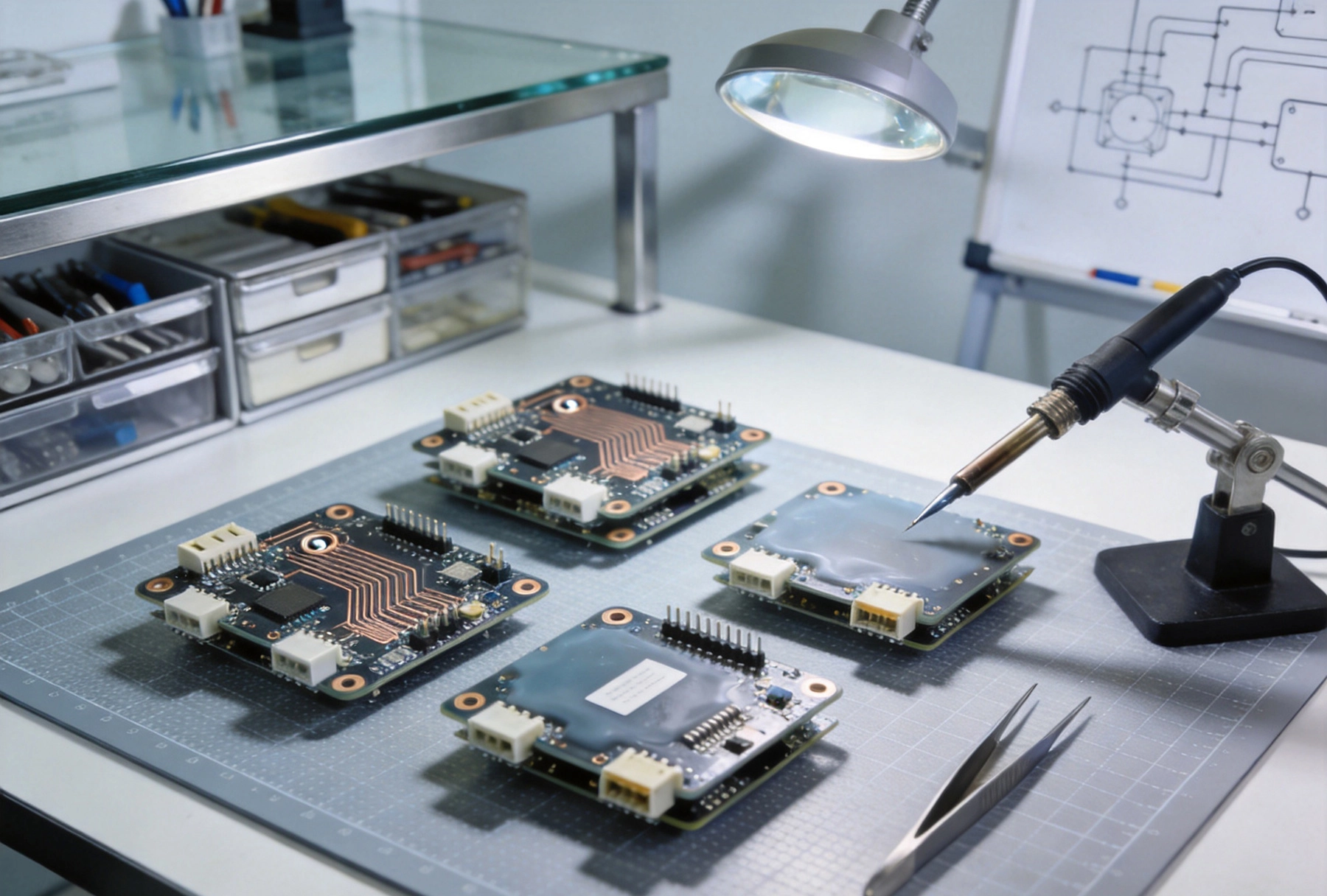
Market validation is the inflection point in Hardware Development where an idea stops being an engineering exercise and starts being a commercial proposition. It is the moment when a product must demonstrate that real customers will pay real money for it, rather than simply proving that the technology works in a lab. Getting to this point with hardware is expensive and slow compared to software, where a minimum viable product can be deployed with a few hundred dollars and a weekend of coding. For hardware, even the most basic market validation run typically requires multiple assembled boards, populated with real components, performing real functions, in real hands. Low volume Turnkey Pcba is the service model that makes this stage affordable, fast, and reliable enough for startups, innovators, and product teams to validate market demand before committing to the full investment of mass production.
The challenge that low volume Turnkey Pcba solves is fundamental: the economics of traditional Pcb Assembly are built for scale. Full production runs assume thousands of boards, long lead times for component procurement, and processes optimized for repetition. A startup that needs 50 boards to validate market demand cannot access those economies of scale, yet they face nearly the same complexity in Component Sourcing, assembly, and test as a company ordering 50,000 boards. Low volume turnkey services are specifically designed to bridge this gap, providing the full Supply Chain, assembly, and testing infrastructure that market validation requires, at quantities and with lead times that match the validation stage of a product.
Software product teams validate market demand through landing pages, beta programs, and early access campaigns, iterating rapidly based on user feedback. The cost of building and iterating a software product is low enough that failure can be absorbed without catastrophic financial damage. A hardware product, by contrast, requires investment in physical materials, tooling, and manufacturing infrastructure before a single unit reaches a customer. If the market does not respond as expected, that investment is largely unrecoverable.
This asymmetry makes market validation disproportionately important for hardware. A Hardware Startup that skips market validation and commits to mass production based on optimistic assumptions about demand is taking on existential risk. The capital required to produce even a modest production run, combined with the lead times involved in component procurement and manufacturing, creates a situation where correcting a wrong market hypothesis is slow and expensive. Low volume turnkey PCBA provides the mechanism to test the market before making that commitment, with limited capital at risk and a short cycle time for iterating based on feedback.
The validation itself takes many forms. A consumer device company may need 100 units to run a beta program with real users. An industrial sensor company may need 25 units to demonstrate to three potential enterprise customers that the product meets their requirements. A medical device company may need 10 units for clinical evaluation before regulatory submission. Each scenario demands assembled boards with real components, real firmware, and real enclosures, not cardboard mockups or simulation results. Low volume turnkey PCBA is the only practical path to producing these units without building an in-house manufacturing capability.
Turnkey PCBA means that a single service provider manages the entire assembly process from design files to finished boards, including PCB fabrication, component procurement, assembly, and testing. The customer submits their design files and receives completed, tested boards ready for integration. This model is particularly powerful for market validation because it eliminates the need for the product team to develop expertise in Supply Chain management, Component Sourcing, and manufacturing process control. These are full-time disciplines that a startup product team cannot afford to staff while simultaneously doing the engineering and business development work that market validation requires.
Low volume turnkey specifically refers to the quantity range that makes market validation feasible: typically from 5 to 500 units, sometimes up to 1,000 depending on the product and the manufacturer. Below this range, the setup costs of manufacturing become disproportionately high relative to the unit value. Above this range, the customer is typically past market validation and moving toward production scale-up. The low volume turnkey window is where a product team can get meaningful market feedback from real physical products without overcommitting capital.
The turnkey model also provides continuity between validation and production. If market validation succeeds and the product moves to production, the same manufacturer that produced the validation units can scale up to production volumes. This continuity reduces the friction of the transition, preserves the manufacturing knowledge gained during validation, and avoids the cost and delay of qualifying a new manufacturer from scratch.
The market validation stage carries several distinct categories of risk that low volume turnkey PCBA specifically addresses. Understanding these risks helps product teams select the right service configuration and negotiate the right terms with their manufacturer.
Supply chain risk is the most significant. Component shortages, counterfeit parts, and long lead times are facts of life in modern Electronics Manufacturing. A startup validating a market on a tight timeline cannot absorb a three-month delay because a single component is out of stock. Low volume turnkey manufacturers maintain relationships with distributors and component manufacturers that provide better access to hard-to-find parts than an individual startup can achieve. They also have the expertise to identify and qualify Alternative Components when originals are unavailable, without requiring the customer to manage the process.
Quality risk is another concern at this stage. A startup cannot afford the inspection and test infrastructure that production manufacturers maintain. A low volume turnkey provider that includes inspection and basic functional test as part of the service reduces the risk that validation units arrive with assembly defects that distort the market feedback. Boards with poor solder joints, wrong components, or missing parts produce unreliable feedback that can lead to incorrect market decisions.
Design risk remains with the customer, but turnkey services reduce the probability that design risk materializes as a manufacturing problem. A manufacturer who reviews the design files for Dfm issues before production can catch problems that would require a board spin or manual rework, saving weeks of delay during the validation stage. The ability to get Dfm feedback from a manufacturing expert before committing to assembly is one of the most valuable but underused features of the turnkey model.
A well-structured market validation engagement with a low volume turnkey PCBA provider follows a predictable workflow that product teams can plan around. Understanding this workflow helps teams set realistic timelines and allocate the right engineering resources at each stage.
The process begins with design preparation and DFM review. The customer submits Gerber files, BOM, and pick-and-place data to the manufacturer, who reviews the design for manufacturability issues, identifies potential component availability problems, and provides a preliminary quote. This stage typically takes one to three days and may surface issues that require a design revision before proceeding. Spending time on this stage is always worthwhile; it is far better to catch a via-in-pad issue or a missing footprint before assembly than to receive boards that cannot be populated correctly.
Component procurement follows the DFM review. The manufacturer sources all components from the BOM, using their distributor relationships to secure availability and competitive pricing. For standard components, this is typically straightforward. For specialized or long-lead components, the manufacturer may identify lead time risks and work with the customer to resolve them. This stage is usually the longest in the process, ranging from one week for standard components to eight weeks or more for custom or scarce parts.
PCB fabrication and assembly run in parallel with the later stages of component procurement. The bare board fabrication typically takes five to ten business days depending on layer count and special requirements. Assembly takes one to five business days depending on board complexity and the manufacturer's schedule. For boards with long-lead components, the assembly is staged to wait for the last-arriving parts.
Test and delivery complete the process. A quality-focused turnkey provider performs AOI or X-ray inspection on the boards, and may perform basic functional test if test fixtures or test procedures are provided. Boards are then packaged and shipped. Total cycle time from design submission to delivery typically ranges from three to six weeks for boards using standard components, and can extend to twelve weeks or more for boards requiring specialized parts.
The quantity of boards needed for effective market validation depends on the validation method and the product category. There is no universal answer, but there are guidelines that product teams can use to plan their Low Volume Pcba requirements.
For consumer products undergoing beta testing with end users, 50 to 200 units is a common range. This quantity is large enough to distribute to a meaningful user cohort and small enough to manage if the product requires firmware updates or hardware revisions between batches. Many consumer hardware companies run two or three validation batches of this size before committing to mass production.
For enterprise or industrial products, the validation quantity is often smaller, driven by the number of potential customers willing to evaluate early-stage products. Ten to fifty units may be sufficient to conduct meaningful evaluations with three to five enterprise prospects, each receiving multiple units for different deployment scenarios. The per-unit value of an industrial product often justifies the higher per-unit cost of low volume assembly.
For medical devices, regulatory-grade documentation and traceability requirements may increase the unit count needed for validation, as some evaluations require more units to demonstrate reliability under use conditions. In medical device development, the distinction between "validation units" and "production units" is also more formal, with regulatory considerations influencing the manufacturing process. A turnkey manufacturer with medical experience can advise on the specific requirements for this case.
Cost management during market validation is a balancing act between minimizing capital at risk and investing enough to generate meaningful feedback. The per-unit cost of Low Volume Pcba is significantly higher than production pricing, reflecting the setup costs that are amortized over smaller quantities. Product teams should plan for this premium rather than being surprised by it.
The most effective cost management strategy during validation is to strip the design to its minimum viable form. Every optional feature, every redundant component, and every enhancement that is not directly required to test the core value proposition adds cost to the validation boards without improving the quality of feedback. A validation board that includes only the features required to test market demand will generate clearer feedback than a fully-featured board, and at a lower total cost.
Component selection has an outsized effect on total cost at low volumes. Proprietary or specialized components that require custom packaging or long lead times add significant cost to the BOM and the procurement process. Using more standard components where possible reduces component costs and accelerates procurement. For components that are truly unique to the product, the product team should plan for higher component costs during validation and use the feedback from validation to optimize the component selection before production.
NPI (New Product Introduction) fees, setup charges, and engineering review fees are common in low volume turnkey services and are worth understanding before beginning a quote process. These charges cover the manufacturing engineer's time for DFM review, the setup of the product in the manufacturer's system, and the process development work required to produce a new product. These costs are fixed regardless of the quantity ordered, which is why per-unit costs drop sharply as quantities increase from 10 to 100 boards.
When market validation succeeds, the transition from low volume validation to production-scale assembly is one of the most critical handoffs in the product lifecycle. Done well, it preserves the manufacturing knowledge, supplier relationships, and process optimizations developed during validation. Done poorly, it reintroduces the risks that were managed during validation and can delay a product launch by months.
The first step in the transition is design freeze. Market validation typically produces feedback that suggests design changes. These changes must be evaluated and either incorporated into the production design or formally deferred. Continuing to iterate the design while simultaneously ramping production is a recipe for supply chain confusion and manufacturing yield problems. A clear design freeze, with a formal change control process for any post-freeze modifications, is essential before committing to production volumes.
Component second-source qualification follows design freeze. During validation, components were selected based on prototype availability. Production volumes may expose supply constraints that were invisible at low volumes. The transition period should be used to qualify Alternative Components for all single-source parts, establish Volume Pricing agreements with distributors, and build buffer stock of long-lead components. The turnkey manufacturer who managed the validation can provide valuable guidance on supply chain risks that only become visible at production scale.
Process optimization for production is the final transition step. The manufacturing process that produced 50 validation boards may need adjustment to produce 5,000. Panelization strategies change at volume. Stencil designs may be optimized for faster printing. Inspection strategies shift from 100 percent coverage to statistical sampling. The manufacturer should conduct a process qualification on the first production batch, treating it as an extension of the NPI phase rather than assuming that the validation process scales linearly to production volumes.
Not all turnkey PCBA providers are equally suited to supporting market validation. The right partner for this stage combines the technical capability to handle complex assemblies with the commercial flexibility to support an early-stage product team.
Engineering engagement is a key differentiator. The best low volume turnkey providers assign a manufacturing engineer to each project who can advise on DFM issues, component selection, and test strategy. This level of engagement is not available at high-volume contract manufacturers that optimize for throughput rather than for customer collaboration. A startup product team benefits more from a manufacturer who will review their design files carefully and flag issues than from a manufacturer who will produce whatever is submitted without comment.
Component sourcing capability varies widely. Some turnkey providers source only from their own inventory, which limits the component options available. Others maintain broad distributor relationships that can source virtually any component. The latter is more valuable for market validation, where the design may use a wide variety of component types and package styles that are not commonly held in inventory.
Testing capability is another important consideration. A turnkey provider who can perform basic functional test on the assembled boards reduces the risk of receiving boards with assembly defects that contaminate market feedback. The more complete the test coverage the provider offers, the more confidence the product team can have in the units they send to validation customers or evaluators.
Low volume turnkey PCBA is the practical enabler of market validation for hardware products. Without it, the capital and time required to produce meaningful quantities of real assembled boards would put market validation out of reach for most startups and product teams. The turnkey model reduces the complexity of the assembly process to a single handoff, provides access to supply chain relationships and manufacturing expertise that individual companies cannot replicate, and creates a foundation for production scaling that preserves the knowledge and supplier relationships built during validation.
The most successful hardware companies treat their low volume turnkey manufacturer as a strategic partner rather than a transactional vendor. They engage the manufacturer early in the design phase, share their market validation goals and timeline constraints, and involve the manufacturer in the transition to production. This collaborative approach extracts more value from the manufacturing relationship than treating it as a competitive bid process, and typically produces better outcomes at every stage of the product lifecycle.
Lead times for low volume turnkey PCBA typically range from three to six weeks from design file submission to board delivery, assuming all components are available from stock or have short lead times. Boards requiring hard-to-find or custom components can extend to ten to twelve weeks. Planning for the longest reasonable component lead time during the validation planning stage prevents unexpected delays.
The appropriate quantity depends on your validation method. For consumer product beta programs, 50 to 200 units is common. For enterprise or industrial evaluation, 10 to 50 units may be sufficient. For medical or regulatory-driven validation, the quantity may be higher. Many product teams run multiple small batches rather than one large validation run, allowing them to incorporate early feedback before committing the full validation quantity.
Yes, many low volume turnkey providers have the capability to assemble boards with BGAs, QFNs, fine-pitch QFPs, and 0201/01005 passive components. This capability is not universal, so confirming the manufacturer's experience with your specific component types before placing an order is important. Providers with strong DFM review processes can also advise on whether the design is optimized for assembly at low volumes.
If market validation reveals that the product does not have sufficient demand, the cost of low volume PCBA represents a bounded loss compared to the loss that would result from committing to mass production without validation. The experience and feedback gained from the validation process also have value, informing future product decisions. A startup that validates early with low volume PCBA has lost less than a startup that skips validation and produces thousands of boards that do not sell.
The transition begins with a formal design freeze after validation is complete, followed by second-source qualification for all single-source components and establishment of Volume Pricing agreements. The same manufacturer who handled validation can typically scale to production with a process qualification run on the first production batch. Planning this transition while the validation units are still in production avoids gaps between validation completion and production launch.
How to Find Manufacturers Specializing in Low Volume Turnkey PCBAJuly/31/2026
Cost Reduction Techniques for High Volume Turnkey PCBA OrdersAugust/03/2026
Why Low Volume Turnkey PCBA is the Perfect Solution for StartupsMay/26/2026
How to Verify Material Quality in Turnkey PCB ManufacturingJuly/30/2026
Low Volume Turnkey PCBA: Flexibility for Niche and Specialized MarketsJuly/09/2026

Overcoming the High Cost Challenges of Low Volume Turnkey PCBAJune/11/2026

Thermal Management Techniques in Power Electronics PCB AssemblyJuly/16/2026
Best Turnkey PCB Assembly for Aerospace, Defense & Avionics: MIL-STD ComplianceJuly/22/2026