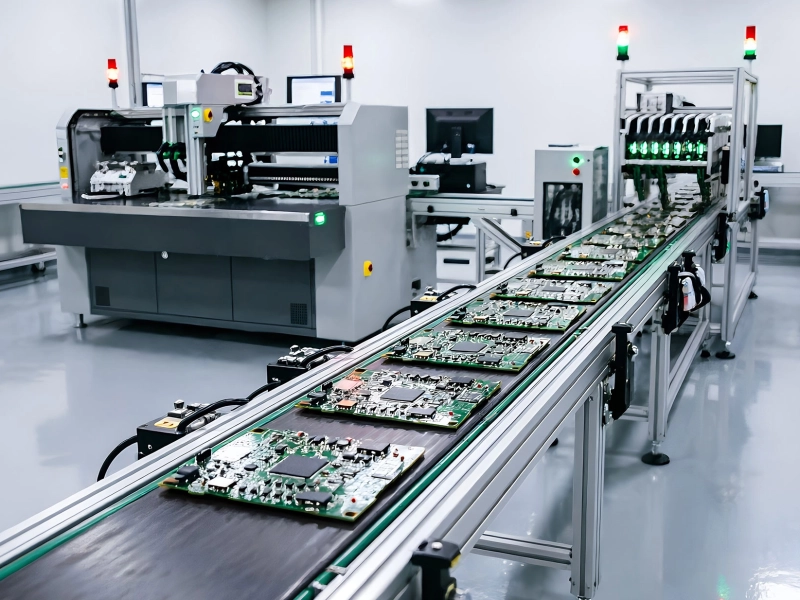
High-volume Turnkey Pcba (Printed Circuit Board Assembly) is a Supply Chain operation as much as it is a manufacturing process. When production scales from hundreds to hundreds of thousands of units, the complexity of logistics and distribution often eclipses the complexity of the assembly itself. A single delayed component shipment, a customs clearance error, or a misrouted pallet can halt an entire production line and trigger cascading penalties across a global Supply Chain. This article examines the critical logistics and distribution challenges in high-volume Turnkey Pcba programs and provides a practical framework for managing them effectively.
1. What Makes Turnkey PCBA Logistics Different?
In a turnkey PCBA arrangement, the Contract Manufacturer (CM) assumes responsibility for the entire production chain: sourcing components, fabricating bare PCBs, assembling the boards, testing, and delivering finished goods. This contrasts with consignment models where the customer provides components and the CM handles only assembly. The turnkey model shifts significant logistics burden onto the CM, but it does not absolve the customer of oversight responsibility.
High-volume turnkey programs introduce several unique logistics challenges:
- Component volume and variety: A single board may require 200+ unique components, each sourced from different distributors, with varying lead times, packaging formats, and shelf-life constraints.
- Global supply chain exposure: Components may originate from Japan, Korea, Taiwan, Europe, and the United States, converging at an assembly facility in China, Vietnam, or Mexico before final distribution to customers worldwide.
- Inventory carrying costs: High-volume programs require strategic inventory buffering, but excess inventory ties up capital and risks obsolescence.
- Regulatory complexity: Export controls, RoHS/Reach Compliance, customs classification, and country-of-origin labeling add layers of administrative overhead.
2. Inbound Logistics: Getting Components to the Line
The inbound logistics phase is where most turnkey PCBA programs encounter their first bottlenecks. Effective inbound management requires coordination across multiple stakeholders and geographies.
2.1 Component Sourcing and Procurement Logistics
In high-volume turnkey programs, component procurement is rarely a simple purchase order exercise. Key considerations include:
- Multi-source qualification: Critical components should have at least two qualified sources to mitigate single-supplier risk. This requires maintaining alternate MPN (Manufacturer Part Number) lists and ensuring cross-qualification is documented.
- Lead time staggering: Components with long lead times (FPGAs, specialized connectors, custom magnetics) must be ordered weeks or months in advance, while passives and standard ICs can be procured on shorter cycles. A procurement schedule aligned to the production ramp curve prevents both shortages and excess inventory.
- Broker and gray-market risk: When authorized distributors cannot meet demand, brokers become tempting. However, counterfeit components in high-volume production can cause field failures that are exponentially more costly than the savings from gray-market sourcing. Establish clear policies on acceptable sourcing channels.
- Reel and packaging integrity: Components shipped on damaged reels or with compromised moisture barrier bags (MBB) may require rebagging or baking before use, adding days to the production schedule. Require vendors to ship with proper ESD and moisture protection.
2.2 Customs Clearance and Import Compliance
Components crossing international borders must clear customs efficiently. Common pitfalls include:
- Incorrect HS codes: Misclassification can result in unexpected duties, customs holds, or even seizure. Work with a licensed customs broker to establish correct HS codes for all imported components.
- Missing documentation: Commercial invoices, packing lists, certificates of origin, and RoHS/REACH declarations must accompany every shipment. Incomplete documentation is the single most common cause of customs delays.
- Duty optimization: Free Trade Agreements (FTAs) and duty drawback programs can significantly reduce landed costs. For example, components imported into a bonded zone for re-export may qualify for duty exemption. Ensure your CM and freight forwarder understand the applicable trade agreements.
2.3 Receiving and Incoming Quality Control (IQC)
Once components arrive at the CM facility, they must be received, inspected, and kitted before reaching the production line. Best practices include:
- Blind receiving vs. ASN-based receiving: Advanced Shipping Notices (ASNs) from suppliers allow the CM to pre-allocate receiving resources and accelerate put-away. Blind receiving (no prior notice) creates bottlenecks during high-volume ramps.
- IQC sampling plans: Not every component requires 100% inspection. Use ANSI/ASQ Z1.4 or similar sampling standards to balance inspection thoroughness with throughput. Critical components (BGAs, connectors, custom parts) should receive higher inspection priority.
- Moisture-sensitive device (MSD) handling: Components with MSL (Moisture Sensitivity Level) ratings of 2 or higher require controlled storage and may need baking before reflow. Track floor life exposure carefully to avoid soldering defects.
3. In-Plant Logistics: Moving Materials Through the Factory
Once components are received and kitted, they must flow efficiently through the production process. In-plant logistics is often overlooked but has a direct impact on throughput and quality.
3.1 Kitting and Line-Side Supply
Kitting is the process of gathering all components required for a specific production batch and delivering them to the SMT line in the correct sequence. Efficient kitting reduces changeover time and minimizes line-side errors:
- Barcode-driven kitting: Each kit should be tracked with a unique barcode that links to the production order. Scanning components into the kit provides traceability and prevents wrong-part errors.
- Just-in-Time (JIT) delivery to line-side: Rather than staging all materials at the line hours in advance, deliver kits in alignment with the production schedule. This reduces line-side clutter and minimizes the risk of using expired or mishandled components.
- Feeder setup verification: Before a production run begins, verify that every feeder on the pick-and-place machine is loaded with the correct component. Automated feeder verification systems can scan feeder barcodes against the BOM to prevent setup errors.
3.2 Work-in-Progress (WIP) Tracking
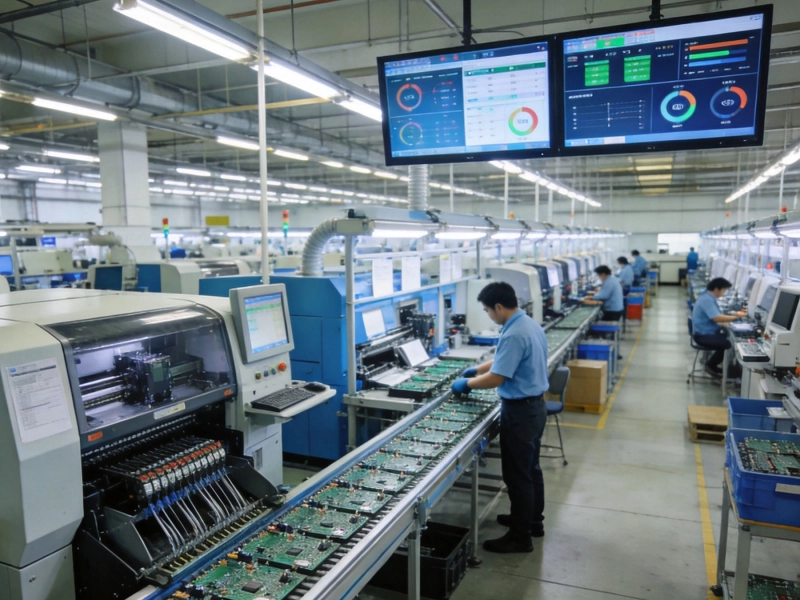
In high-volume production, thousands of boards may be in various stages of completion at any given time. Real-time WIP tracking through the MES (Manufacturing Execution System) provides visibility into:
- Board location (which machine or station)
- Process status (SMT placed, reflowed, tested, boxed)
- Yield metrics at each stage
- Bottleneck identification (where boards are queuing)
Without WIP tracking, production managers are flying blind—unable to predict completion dates or identify quality issues until it is too late.
3.3 Internal Material Handling
Boards moving between SMT, THT, testing, Conformal Coating, and final assembly must be handled with care to prevent ESD damage, mechanical stress, and contamination. Key practices include:
- ESD-safe transport: All internal transport containers, carts, and racks must be ESD-safe. Regular ESD audits should verify grounding integrity.
- Panelization handling: Large panels should be transported in dedicated panel racks to prevent warpage and component damage. Manual handling of large panels by operators increases the risk of dropped boards.
- Cleanliness protocols: Boards moving between processes should be protected from dust, oil, and moisture. Covered carts and clean-room protocols are essential for high-reliability products.
4. Outbound Logistics: Getting Finished Goods to Customers
Once boards are assembled, tested, and packed, they must reach the customer's facility—or the customer's end users—on time and in perfect condition. Outbound logistics in high-volume turnkey PCBA involves several critical decisions.
4.1 Packaging and Shipping Preparation
Proper packaging protects boards during transit and ensures compliance with customer requirements:
- ESD-safe packaging: Every board should be sealed in an ESD-safe bag with desiccant and humidity indicator cards (HIC) if moisture sensitivity is a concern.
- Anti-vibration packaging: For boards with large or heavy components (transformers, large capacitors, connectors), use foam inserts or molded pulp trays to prevent solder joint fatigue during transit.
- Labeling compliance: Shipping labels must include PO numbers, part numbers, lot/batch codes, quantity, country of origin, and any customer-specific labeling requirements. Incorrect labeling can cause receiving rejections at the customer's warehouse.
- Palletization standards: For full-container or LTL (Less-Than-Truckload) shipments, palletize according to ISPM 15 standards (heat-treated or fumigated wood) to meet international phytosanitary requirements.
4.2 Freight Mode Selection
Choosing the right freight mode balances cost, speed, and risk:
| Freight Mode | Best For | Typical Transit Time | Cost Relative to Air |
|---|
| Air Express (DHL, FedEx, UPS) | Urgent prototypes, line-down situations | 2–5 days | 100% (baseline) |
| Air Freight (consolidated) | High-value, time-sensitive production runs | 5–10 days | 40–60% |
| Ocean FCL (Full Container Load) | High-volume, non-urgent shipments | 20–40 days | 10–20% |
| Ocean LCL (Less than Container Load) | Medium-volume shipments sharing container space | 25–45 days | 15–25% |
| Rail (China-Europe) | Mid-value goods to European destinations | 12–18 days | 25–35% |
For high-volume turnkey programs, a hybrid approach is common: air freight for initial production runs to meet launch deadlines, transitioning to ocean freight for steady-state replenishment once demand stabilizes.
4.3 Distribution Models
How finished goods flow from the CM to end customers depends on the business model:
- Direct shipment to customer DC: The CM ships finished goods directly to the customer's distribution center. Simplest model but requires the customer to manage their own downstream logistics.
- Drop shipment to end customers: The CM ships individual orders directly to end customers on behalf of the OEM. This requires the CM to have robust order management and parcel shipping capabilities.
- Hub-and-spoke distribution: Finished goods are shipped to regional distribution hubs (e.g., one in North America, one in Europe, one in Asia), from which they are distributed to local customers. This model reduces transit times to end users but increases inventory carrying costs.
- VMI (Vendor Managed Inventory): The CM maintains inventory at or near the customer's facility and replenishes based on consumption signals. This shifts inventory risk to the CM but provides the customer with near-zero lead times.
5. Technology Enablers for Logistics Visibility
Modern high-volume turnkey PCBA programs rely on a stack of technology systems to maintain logistics visibility and control:
- ERP (Enterprise Resource Planning): Systems like SAP, Oracle, or NetSuite provide the financial and procurement backbone, tracking purchase orders, inventory valuation, and cost accounting.
- MES (Manufacturing Execution System): Tracks production progress in real time, linking each board to its component lot codes, test results, and operator records for full traceability.
- WMS (Warehouse Management System): Manages inbound receiving, put-away, picking, kitting, and outbound shipping within the CM's warehouse. Barcode scanning at every touchpoint ensures accuracy.
- TMS (Transportation Management System): Optimizes freight routing, carrier selection, and shipment tracking. Provides real-time visibility into in-transit shipments and estimated arrival times.
- Supply Chain Control Tower: A dashboard-level view that aggregates data from ERP, MES, WMS, and TMS systems, providing end-to-end visibility from component PO to customer delivery. Increasingly powered by AI for predictive alerts (e.g., "Shipment X is at risk of delay due to port congestion").
6. Risk Management and Contingency Planning
Even the best-planned logistics operations encounter disruptions. High-volume turnkey programs must have contingency plans for common failure modes:
- Component shortages: Maintain safety stock for critical components and pre-qualify alternate sources. Consider consignment inventory agreements with key distributors.
- Port congestion and freight delays: Diversify shipping routes and maintain relationships with multiple freight forwarders. For ocean shipments, consider alternative ports to avoid bottlenecks.
- Quality escapes: Implement robust outgoing quality control (OQC) and retain sample boards from each production lot for traceability. Establish clear RMA (Return Merchandise Authorization) procedures with the CM.
- Geopolitical and trade disruptions: Tariff changes, export controls, and trade restrictions can upend supply chains overnight. Maintain scenario plans for shifting production between geographic regions (e.g., China to Vietnam or Mexico).
- Natural disasters: Earthquakes, typhoons, and floods can disrupt both component supply and assembly operations. Geographic diversification of suppliers and CMs reduces single-point-of-failure risk.
7. Key Performance Indicators (KPIs) for Logistics Excellence
Measuring logistics performance is essential for continuous improvement. Key KPIs for high-volume turnkey PCBA programs include:
| KPI | Target | Why It Matters |
|---|
| On-Time Delivery (OTD) | >95% | Measures the CM's ability to meet committed delivery dates |
| Perfect Order Rate | >98% | Orders delivered complete, on time, undamaged, with correct documentation |
| Inventory Turns | 8–12x annually | Higher turns indicate efficient inventory management and reduced carrying costs |
| Inbound Lead Time Variance | <10% deviation | Measures consistency of component delivery from suppliers |
| Freight Cost as % of COGS | Industry-dependent | Tracks logistics cost efficiency; benchmark against industry peers |
| Customs Clearance Time | <48 hours | Prolonged clearance indicates documentation or classification issues |
| Damage Rate in Transit | <0.1% | Measures packaging effectiveness and carrier handling quality |
Conclusion
Managing logistics and distribution in high-volume turnkey PCBA is a multidimensional challenge that spans global procurement, customs compliance, in-plant material flow, outbound freight optimization, and risk mitigation. The most successful programs treat logistics not as a back-office function but as a core competitive capability. By investing in visibility technology, building resilient supplier relationships, maintaining contingency plans, and measuring performance rigorously, OEMs and their CM partners can transform logistics from a source of risk into a source of advantage. In an era where supply chain disruptions are the norm rather than the exception, logistics excellence is what separates reliable manufacturers from the rest.