
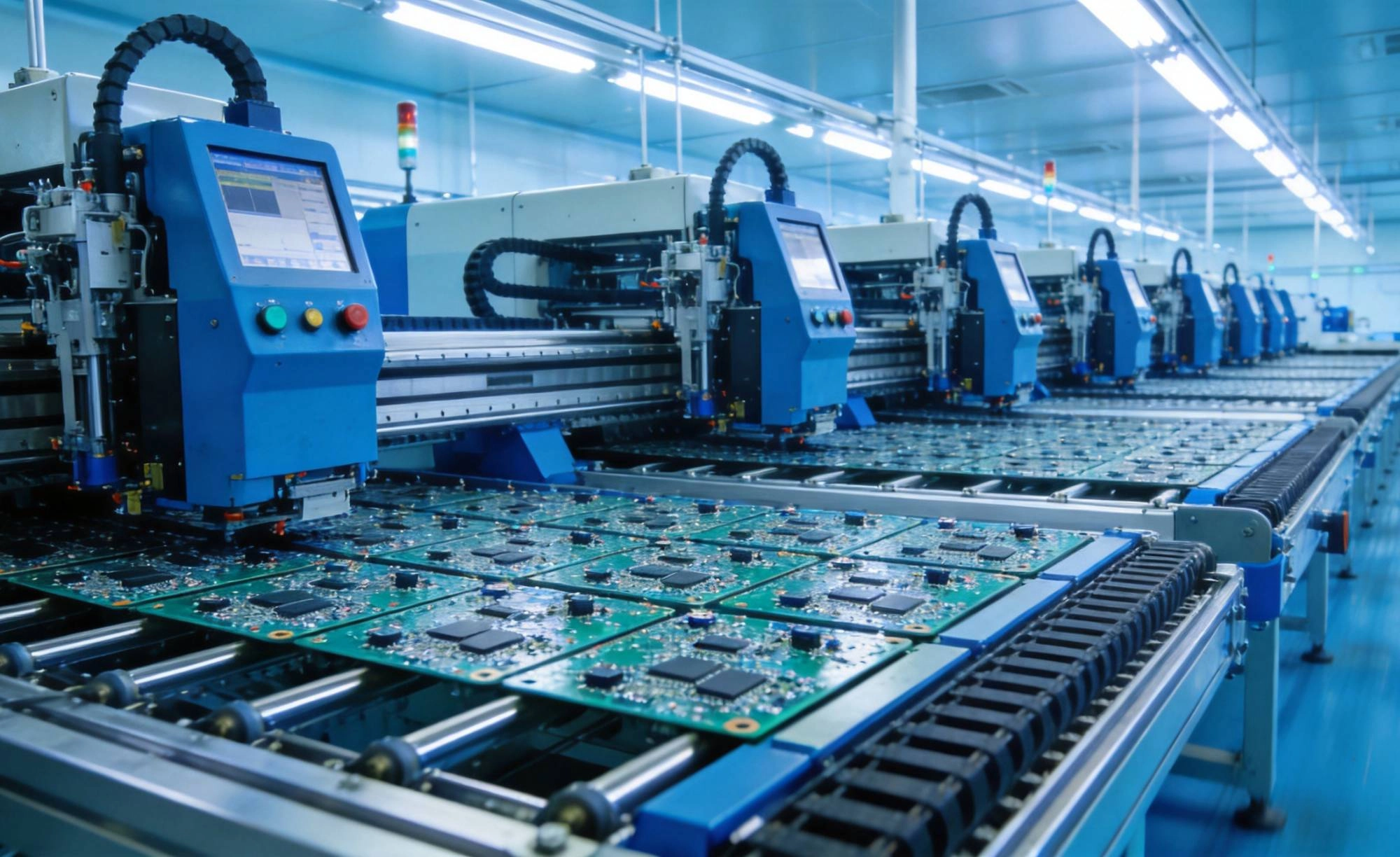
High volume Turnkey PCB Assembly orders represent both opportunity and challenge. Production volumes above 10,000 units create leverage for cost optimization, but realizing that leverage requires deliberate strategy and technical expertise. The difference between a good price and an exceptional price often comes down to understanding which cost levers create the biggest impact. Companies that approach high volume manufacturing with systematic cost reduction strategies typically achieve 15-30 percent cost advantages over competitors who simply accept standard pricing. This cost margin can determine market leadership, especially in price-sensitive Consumer Electronics and competitive industrial equipment markets.
Before implementing specific cost reduction techniques, understand where your money goes in high volume assembly. Component costs typically consume 60-80 percent of total assembly cost for moderate-complexity boards, making component sourcing the largest cost reduction opportunity. Fabrication costs, including materials and processing, typically represent 15-25 percent of total cost. Assembly labor, test, and overhead make up the remaining 5-15 percent, with the exact split depending on process complexity and geographic location.
These proportions change based on product characteristics. Simple boards with low component counts see higher labor percentages relative to total cost. Complex boards with expensive BOMs see component costs consuming 85 percent or more of total cost. Understanding your specific cost structure directs cost reduction efforts toward the highest-impact areas rather than pursuing reductions that save pennies while missing dollars.
The most effective cost reductions happen during design, not after engineering is complete. Component selection decisions made early in product development determine a significant portion of final assembly cost. When multiple components meet technical requirements, choose the one with the greatest manufacturing advantage. Look for components available from multiple sources to prevent allocation pricing, prefer industry-standard packages over custom footprints, and select components with established manufacturing maturity rather than cutting-edge parts with limited availability.
Component consolidation creates additional savings opportunities. When your design uses multiple capacitor values of the same voltage rating and package size, consider whether you can consolidate to fewer standard values and adjust circuit values accordingly. Standard values enjoy higher production volumes and better pricing than non-standard values. Similar consolidation opportunities exist for resistor values, inductors, and other passive components where specification tolerance permits substitution.
Turnkey Assembly partners typically handle component purchasing, but you can influence their approach through communication about volume commitments and price targets. Provide your assembly partner with accurate demand forecasts for at least 12 months, preferably 18-24 months for high volume products. These forecasts enable the partner to negotiate better pricing with component suppliers and establish inventory positions that protect against allocation without carrying excess stock.
Direct manufacturer purchasing bypasses distributor margins for high volume components. For components with annual consumption above $50,000 per year, ask your assembly partner whether direct purchasing from component manufacturers provides cost advantages. Direct relationships typically deliver 5-15 percent savings compared to distributor pricing, though they require volume commitments that align with your production projections.
Component sourcing channel selection balances cost against counterfeit risk. Authorized distributors provide Supply Chain security and counterfeit protection but typically carry higher prices than independent distributors. For non-critical components where counterfeit risk is minimal, independent distributors can provide 20-30 percent cost savings. However, this strategy requires careful Supplier Qualification and robust incoming inspection to mitigate counterfeit risk.
Develop a component sourcing strategy that categorizes components by counterfeit risk and cost sensitivity. High-risk components like microcontrollers, FPGAs, and complex ASICs should always come from authorized channels. Standard resistors, capacitors, and discrete semiconductors with established market presence can safely come from independent distributors when suppliers demonstrate reliable quality systems and traceability.
Maximizing panels per production run directly reduces per-unit fabrication and assembly cost. Effective panelization considers board dimensions, process margins, and routing optimization to fit the maximum number of boards on each production panel. Working with your PCB fabricator and assembly partner early in the design process enables panelization decisions that optimize for both fabrication capability and assembly efficiency.
Board dimensions significantly impact panelization efficiency. Standard panel sizes like 18 by 24 inches or 20 by 24 inches represent the canvas for optimization. Designing boards with dimensions that create efficient packing patterns within these standard panel sizes improves utilization from 70 percent to 85 percent or better. This improvement reduces material waste and increases throughput, both contributing to lower per-unit cost.
Every assembly operation adds cost. Reducing the number of distinct assembly steps directly reduces labor cost and improves yield. Look for opportunities to reduce component counts by integrating functions where possible. Consider whether multiple passive components can be replaced with integrated passives or whether complex multi-chip solutions offer cost advantages compared to discrete implementations.
Component placement efficiency matters as well. Standardizing component footprints and orientations reduces machine setup time and changeovers. Designing boards with component placements that enable efficient pick-and-place patterns—minimizing machine movements and head rotations—improves throughput and reduces per-unit assembly time. Discuss your design with assembly engineers who understand machine capabilities before finalizing placement decisions.
Test cost represents a significant but often overlooked expense in High Volume Production. Functional test development typically requires significant NRE investment, and test time per unit adds directly to assembly cost. Designing products for testability reduces test development time and per-unit test duration.
Include test access points for critical nodes, provide isolation for power rails, and design circuits that support boundary scan when possible. Consider whether built-in self-test capabilities can reduce reliance on external test equipment. Products designed for testability typically see 20-40 percent lower test cost compared to designs that require test engineers to develop complex workarounds.
Volume purchasing creates negotiation leverage, but leveraging that leverage requires preparation. Before negotiating pricing, gather competitive quotes from multiple assembly partners to establish market benchmarks. Understand your partner's cost structure well enough to identify pricing that reflects realistic margins rather than arbitrary markups.
Negotiate multi-year agreements with volume commitments in exchange for committed pricing. These agreements provide your partner with predictable production forecasts that justify capital investment and inventory positioning, while you lock in pricing protection against inflation and component price increases. Ensure agreements include flexibility clauses that accommodate volume variations without triggering penalty pricing.
Manufacturing location significantly affects labor cost, but total cost considerations should include logistics, tariffs, and Supply Chain risk. Low-cost offshore locations provide labor advantages that can reach 40-50 percent compared to domestic manufacturing, but extended supply chains increase logistics costs, reduce agility, and create vulnerability to disruptions.
Many companies optimize total cost through nearshore manufacturing that balances labor savings with logistics efficiency. Mexico manufacturing for North American markets or Eastern European manufacturing for European markets often delivers optimal total cost when considering freight, customs, Time To Market, and Supply Chain Resilience. Evaluate total delivered cost rather than just manufacturing cost when selecting production locations.
Lean manufacturing principles that eliminate waste create continuous cost reduction opportunities. Work with your assembly partner to identify and eliminate non-value-added activities like excessive material handling, redundant inspections, and unnecessary documentation. Single-minute exchange of die (SMED) techniques reduce setup times between production runs, improving equipment utilization and reducing per-unit overhead.
Statistical process control prevents rework and scrap by catching process variations before they create defects. Implementing SPC requires investment in measurement systems and training, but the return comes through improved yields that reduce material waste and rework labor. High Volume Production magnifies the impact of yield improvements—a 2 percent yield increase on a 100,000 unit annual production run saves 2,000 units of material cost and assembly labor.
Designing product families around common platforms creates economies of scale that reduce cost across multiple products. When multiple products share common circuitry, components, and subassemblies, the combined volume enables better pricing for shared elements. Component commonality reduces inventory complexity and purchasing overhead while increasing volume leverage with suppliers.
Platform strategies require upfront planning but deliver sustained cost advantages throughout product lifecycles. Analyze your product portfolio to identify opportunities for common power supplies, processor platforms, and interface modules. Even when end products differ significantly, underlying architectures can share significant content when designed with commonality in mind.
Component lifecycle management prevents cost increases from obsolescence and allocation. Proactively monitor component end-of-life notices and plan migrations before components become unavailable. Last-time buy decisions require careful analysis of expected product lifetime versus cost of re-engineering for replacement components.
Implementing proactive component lifecycle management programs with your assembly partner creates a systematic approach to obsolescence risk. These programs track component market status, recommend alternatives before problems arise, and coordinate last-time buy purchases when appropriate. The cost of proactively managing obsolescence is far lower than the cost of emergency redesign and requalification when components become unavailable.
What volume justifies implementing dedicated cost reduction programs?
The volume threshold varies by product complexity and cost structure, but generally annual volumes above 10,000 units justify dedicated cost reduction programs. Below this threshold, the effort required for systematic cost optimization may not generate returns that justify the investment. However, even at lower volumes, smart component selection and basic Dfm practices deliver cost benefits without requiring dedicated programs.
How much can I realistically expect to save through cost reduction efforts?
Realistic cost reduction potential depends on your starting point. Products designed without Dfm consideration often see 15-25 percent savings from basic optimization. Products already optimized for manufacturing typically see 5-10 percent additional savings from advanced techniques. The most significant savings come from early-stage design decisions rather than later-stage production optimization.
Should cost reduction ever compromise quality or reliability?
Cost reduction should never compromise fundamental quality or reliability requirements. However, the definition of "quality" often includes unnecessary specifications that drive cost without adding customer value. Challenge every specification and requirement to confirm it delivers customer-perceived value. When specifications reflect genuine customer needs rather than engineering preference, cost reduction and quality improvement become complementary rather than conflicting objectives.
How do I balance cost reduction against Time-to-market requirements?
Time-to-market and cost reduction require careful balancing. Rushing product development to beat competitors to market often prevents thorough cost optimization. The most successful companies separate fast-track development for initial production from subsequent cost optimization efforts. Launch products quickly with acceptable margins, then implement cost reduction programs for later production runs once Market Validation confirms volume expectations.
What role should my assembly partner play in cost reduction?
Your assembly partner should be a collaborative partner in cost reduction rather than just a vendor. Engage them early in the design process for DFM reviews, involve them in component selection discussions, and request their input on test strategy development. Partners who demonstrate proactive cost reduction suggestions deliver more value than those who only respond to specific cost reduction requests.
Cost reduction for high volume Turnkey Assembly requires systematic, sustained effort across multiple dimensions. Component sourcing optimization, Design For Manufacturing, process efficiency improvements, and strategic supplier relationships all contribute to achieving cost advantages that strengthen market position. Companies that approach high volume manufacturing with deliberate cost reduction strategies consistently outperform competitors who treat cost as an afterthought.
The most effective cost reductions happen during design, but continuous improvement programs that capture lessons learned from production drive ongoing optimization throughout product lifecycles. View cost reduction as a continuous process rather than a one-time initiative, engaging your assembly partner as a collaborative participant rather than an adversary. The partnership approach that aligns incentives creates the most sustainable cost advantages.
Start by understanding your specific cost structure, then implement the highest-impact techniques first. Component selection and panelization typically deliver the biggest returns for the smallest investment. As you demonstrate success with initial techniques, expand your cost reduction program to include more sophisticated approaches. The cumulative effect of multiple 5-10 percent improvements compounds to create significant competitive advantages.
Low Volume Turnkey PCBA: Flexibility for Niche and Specialized MarketsJuly/09/2026

Overcoming the High Cost Challenges of Low Volume Turnkey PCBAJune/11/2026
The Role of Low Volume Turnkey PCBA in Market ValidationSeptember/08/2026

Why Low Volume Turnkey PCBA is the Perfect Solution for StartupsMay/26/2026
How to Verify Material Quality in Turnkey PCB ManufacturingJuly/30/2026
How to Find Manufacturers Specializing in Low Volume Turnkey PCBAJuly/31/2026

High Volume Turnkey PCBA: The Importance of Automated Assembly LinesSeptember/09/2026

Turnkey PCB Assembly Insights: The Shift Towards High-Mix Low-Volume ProductionJuly/02/2026