
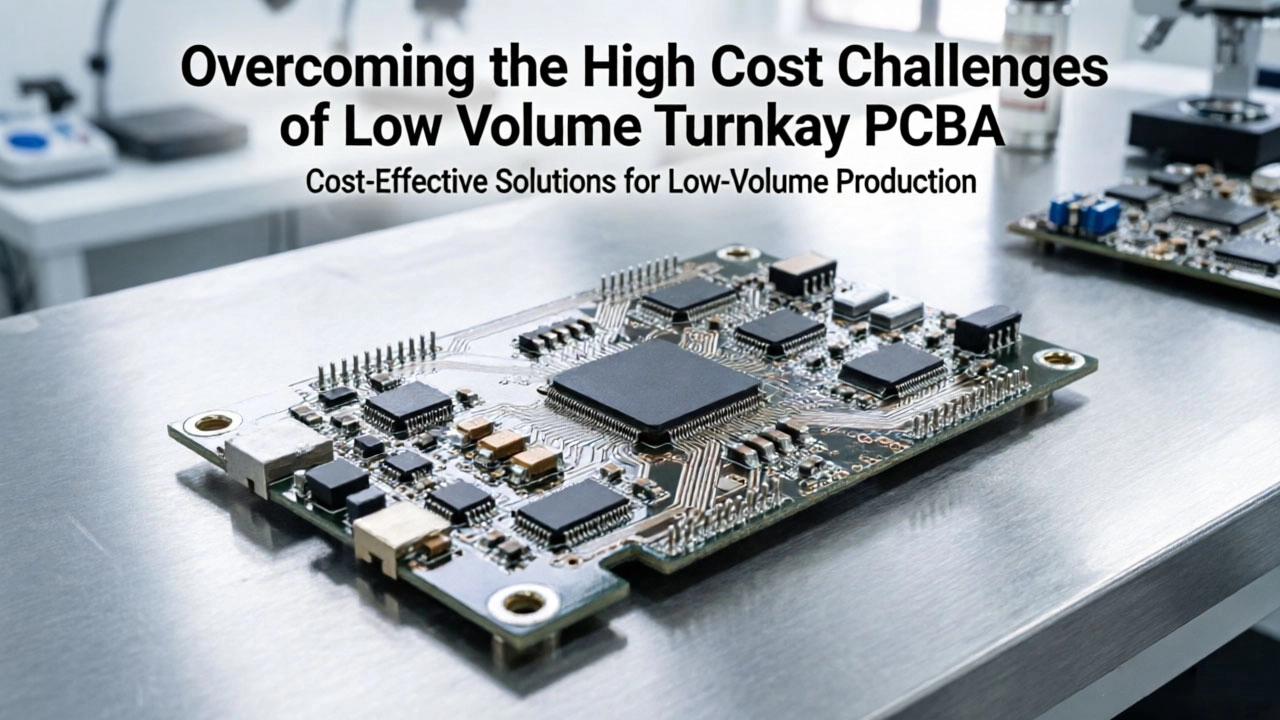
If you are an engineer or a startup founder, you probably know the sinking feeling of opening a quote for a small batch of circuit boards. Overcoming the High Cost Challenges of Low Volume Turnkey PCBA is one of the most common headaches in Hardware Development. You have a brilliant prototype, but when you ask for 50 or 100 assembled boards, the price per unit looks absolutely terrifying.
I’ve been in this exact spot many times. A few years ago, I was working on an IoT sensor node, and the manufacturer quoted me $120 per board for a run of just 50 units. I realized that fixed costs like machine setup, stencils, and engineering fees were completely eating up my budget. In this article, I will share some practical, real-world strategies to help you slash those costs without sacrificing quality. Let's dive into how you can make low-volume manufacturing actually affordable.
To start Overcoming the High Cost Challenges of Low Volume Turnkey PCBA, you first need to understand why it is so expensive. Factories charge high premiums for small batches because their profit margins rely on volume. When they process 50 boards, they still need to set up the pick-and-place machines, load the feeders, and do the programming. These fixed costs get divided by a tiny number, making your per-unit price skyrocket.
One effective way to fight this is by merging orders. If you are testing multiple variations of a board, try to keep the PCB outline and layer stack-up identical. Some turnkey providers offer "panelization" services where they combine your small batch with other customers' similar orders to share the setup costs. Also, don't be afraid to negotiate the "engineering fee." Many factories will waive or reduce this fee if they see potential for future mass production.
Nothing destroys a budget faster than having to manufacture a second batch because the first one had soldering issues. When Overcoming the High Cost Challenges of Low Volume Turnkey PCBA, Design for Manufacturability (Dfm) is your best friend. If you place components too close to the board edge, or use tiny 0201 resistors that require ultra-high-precision placement, the factory will charge you premium rates.
In my experience, switching from 0201 to 0402 passive components saved me about 15% in assembly costs on a recent project. Standard components are faster to place and less prone to tombstoning. Always ask your turnkey provider for a free Dfm review before placing the order. Catching a footprint mismatch during the design phase is free; catching it after the boards are assembled will cost you weeks of delay and thousands of dollars.
The bill of materials (BOM) usually accounts for over half of your total cost. To succeed in Overcoming the High Cost Challenges of Low Volume Turnkey PCBA, you must be strategic about sourcing. Never use obscure, single-source components unless absolutely necessary. If a specific microcontroller goes out of stock, your production line stops, and expedited shipping fees will ruin your margins.
A great trick is to let the turnkey factory handle the sourcing. Because they buy components in massive volumes for all their clients, they often get better pricing than you can find on retail sites. Furthermore, always provide alternate part numbers in your BOM. Giving the factory permission to use a second-source equivalent can prevent massive delays and price spikes during shortages.
Time is money, but so is patience. Instead of ordering 10 boards every time you tweak a resistor value, plan your iterations carefully. When Overcoming the High Cost Challenges of Low Volume Turnkey PCBA, batching your needs is crucial. Try to group multiple small projects together if they share similar requirements.
Some advanced turnkey platforms allow you to combine different designs into a single panel (known as panel sharing). This means you only pay for one stencil and one setup fee, even if you are building three different products. Just make sure to add proper breakaway tabs and tooling holes so the boards don't get damaged during assembly.
Overcoming the High Cost Challenges of Low Volume Turnkey PCBA isn't just about finding the cheapest vendor; it's about optimizing your entire approach. By designing with standard components, utilizing DFM checks, letting experts handle procurement, and batching your orders, you can bring those crazy quotes down to earth.
Don't let high prototyping costs stall your innovation. Start applying these strategies today, communicate openly with your manufacturer, and watch your Hardware Development budget transform from a nightmare into a manageable reality.
Q: Should I supply my own parts to save money?
A: Usually no. Unless you have special negotiated pricing, turnkey factories buy cheaper due to volume. Supplying your own also shifts the risk of missing or fake parts onto you.
Q: How much can DFM really save me?
A: Proper DFM can save anywhere from 10% to 30% by eliminating complex manual soldering steps, reducing test failures, and avoiding costly rework loops.
Q: Is it cheaper to separate PCB fabrication and assembly?
A: For low volume, turnkey is almost always cheaper. Separating them means you pay double shipping, deal with two vendors, and take on the risk of bare board damage during transit.
Why Low Volume Turnkey PCBA is the Perfect Solution for StartupsMay/26/2026
Low Volume Turnkey PCBA: Flexibility for Niche and Specialized MarketsJuly/09/2026
Cleanroom Manufacturing Standards for Implantable Medical PCBAJuly/21/2026
Turnkey PCB Assembly Insights: The Shift Towards High-Mix Low-Volume ProductionJuly/02/2026
What Are Turnkey PCB Services?May/26/2026
Best Turnkey PCB Assembly for Consumer & IoT ElectronicsJune/16/2026
How Turnkey PCB Prototyping Reduces Development Cycles by 40%June/05/2026
Turnkey PCB Manufacturing: Integrating Fabrication and Assembly SeamlesslyMay/26/2026