Open Nav

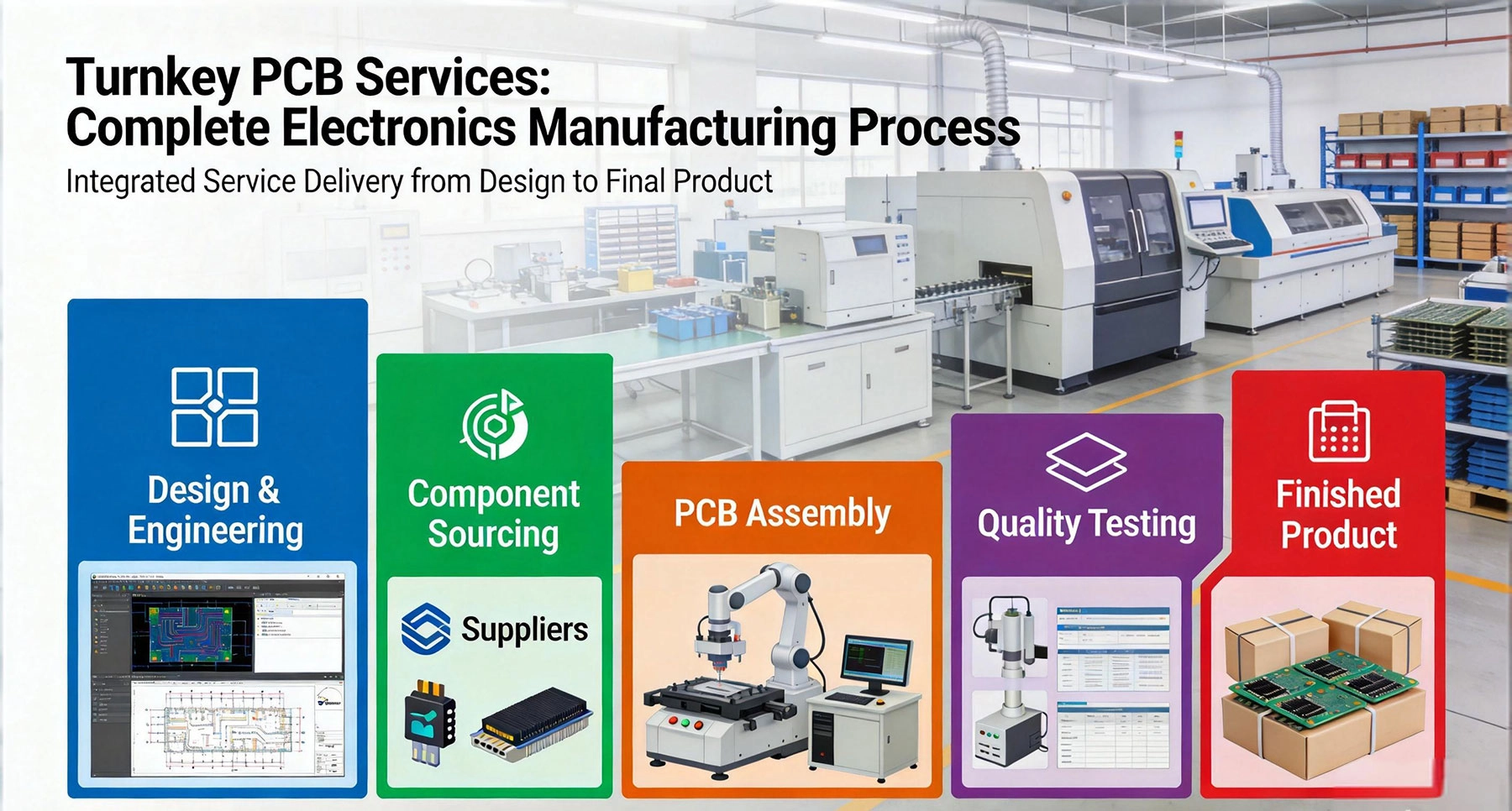
Turnkey Pcb services represent a comprehensive approach to Electronics Manufacturing where a single provider manages the entire production process from start to finish. The term "turnkey" derives from the concept that customers receive a finished, tested product ready for integration—like turning a key to unlock a completed solution. This integrated service model contrasts with fragmented approaches requiring customers to coordinate multiple vendors across different production stages.
In traditional Pcb Assembly, customers often separate fabrication, component procurement, assembly, and testing across multiple suppliers. This fragmentation creates coordination complexity, increases communication overhead, and introduces compatibility risks between stages. Turnkey services consolidate these activities under one provider, streamlining production while transferring coordination responsibility from customer to manufacturer.
This guide provides comprehensive definition and overview of Turnkey Pcb services, explaining service components, comparing alternatives, analyzing advantages and limitations, and helping you determine whether turnkey solutions fit your manufacturing requirements. Understanding turnkey services enables informed partnership decisions aligned with project complexity, resource constraints, and quality expectations.
Turnkey PCB Assembly encompasses the complete Electronics Production workflow, integrating multiple service elements into unified delivery:
The turnkey concept extends beyond service bundling to encompass responsibility integration. Turnkey providers accept accountability for production outcomes across all stages, not just isolated operations. This comprehensive responsibility model simplifies customer experience while concentrating Quality Assurance under unified management.
Practical turnkey service delivery involves:
True turnkey services differ from "bundled services" where providers offer multiple capabilities but maintain fragmented responsibility structures. Authentic turnkey delivery integrates both services and accountability, providing customers with comprehensive solution delivery rather than coordinated vendor management.
Partial assembly services provide specific production stages rather than complete workflows. Customers using partial services retain responsibility for stages outside provider scope, requiring vendor coordination and compatibility management.
Partial assembly service types:
Partial services suit customers with established Supply Chain relationships, specialized component requirements, or cost optimization strategies leveraging separate vendor pricing. However, partial approaches require customer coordination capability and Supply Chain management expertise that many product developers lack.
Consignment assembly represents a specific partial service model where customers supply all materials—fabricated boards and components—to assembly providers. Providers execute soldering and mounting operations using supplied materials, with limited responsibility beyond assembly execution.
Consignment assembly characteristics:
Consignment suits customers with specialized components, proprietary supply relationships, or regulatory requirements mandating specific component sources. However, consignment requires customers possess Supply Chain Management expertise and accept responsibility for material-related production problems.
Selecting between turnkey, partial, and consignment services depends on project requirements, customer capabilities, and strategic priorities:
| Service Model | Best For | Customer Requirements |
|---|---|---|
| Turnkey | Complete production without Supply Chain Management | Design files, specifications, acceptance criteria |
| Partial Assembly | Customers with established supply relationships | Supply chain management capability, vendor coordination expertise |
| Consignment | Specialized components, proprietary sourcing | Component procurement expertise, material quality verification capability |
Most product developers benefit from turnkey services unless specific circumstances justify partial or consignment approaches. Supply chain management complexity often exceeds customer capabilities, making turnkey integration valuable despite potential cost differences.
Turnkey services eliminate coordination complexity by consolidating production stages under single management. Customers interact with one provider rather than multiple vendors, simplifying communication, scheduling, and problem resolution.
Coordination benefits:
Turnkey providers possess supply chain infrastructure, supplier relationships, and procurement expertise that individual customers rarely match. Leveraging provider supply chain capability improves component availability, reduces procurement lead times, and ensures component quality.
Supply chain advantages:
Turnkey services integrate quality management across production stages, ensuring fabrication quality supports assembly requirements and testing verifies complete functionality. Unified quality responsibility eliminates compatibility risks between separately managed stages.
Quality benefits:
Integrated production scheduling optimizes workflow across service stages, reducing delays caused by inter-vendor coordination gaps. Turnkey providers sequence fabrication, procurement, assembly, and testing efficiently, minimizing production cycle time.
Time efficiency gains:
Turnkey services may cost more than coordinated partial services when customers possess effective supply chain capability and can optimize pricing across separate vendors. Turnkey providers markup component costs and include service integration overhead that fragmented approaches avoid.
Cost considerations:
However, cost comparison requires accounting for customer supply chain management overhead, coordination time, and quality risks. Actual cost differences often favor turnkey when including customer management costs, not just vendor pricing.
Turnkey providers may restrict component selection to suppliers within their approved networks, limiting customer ability to specify preferred component brands or specialized suppliers. This constraint affects projects requiring specific component characteristics or proprietary sourcing relationships.
Flexibility limitations:
Turnkey relationships create dependency on single provider capability across production stages. Provider capacity limitations, quality problems, or business continuity issues affect complete production workflow, not isolated operations. Customers relinquish direct control over fabrication and procurement decisions.
Dependency considerations:
Turnkey quotations often aggregate costs across services and components, limiting visibility into individual cost elements. Customers seeking to understand component pricing, fabrication costs, or assembly fees separately may encounter resistance from providers protecting bundled pricing models.
Transparency challenges:
Turnkey services suit specific project characteristics where integrated production delivery provides clear value:
Certain project characteristics favor partial or consignment approaches over turnkey services:
Selecting appropriate turnkey provider requires evaluating capabilities supporting integrated production delivery:
Clarify service delivery specifics through targeted questions:
Cost comparison requires comprehensive analysis including customer supply chain management overhead, not just vendor pricing. Turnkey services often achieve cost efficiency through provider supply chain expertise, volume purchasing, and efficiency gains exceeding customer-managed alternatives. Actual cost depends on customer procurement capability, project volume, and provider pricing structure.
Turnkey services consolidate production management, not eliminate customer engagement. Customers provide design files, specifications, acceptance criteria, and approval for key decisions. Turnkey reduces coordination complexity but requires ongoing communication and decision-making support throughout production.
Turnkey service depth varies significantly across providers. Some offer comprehensive integration with unified quality management and accountability. Others provide bundled services without integrated responsibility, requiring customers to manage inter-stage compatibility despite service consolidation. Evaluate providers based on actual integration depth, not service bundling claims.
Provider component flexibility varies. Many turnkey providers accept customer-specified components when customers supply acceptable documentation and sourcing information. Restriction claims often reflect provider limitations rather than inherent turnkey constraints. Verify specific provider policies before assuming component flexibility limitations.
Turnkey Pcb Services provide comprehensive production solutions integrating fabrication, component procurement, assembly, testing, and logistics under unified provider management. This integrated approach simplifies customer experience, leverages provider supply chain expertise, ensures quality integration, and compresses production timelines through optimized workflow scheduling.
Turnkey services suit projects requiring complete production without supply chain management overhead, prototype development demanding rapid turnaround, small-batch production avoiding coordination complexity, and resource-constrained organizations lacking procurement infrastructure. Alternative partial and consignment models serve specialized component requirements, high-volume cost optimization, and established supply chain capability scenarios better.
Selecting turnkey providers requires evaluating comprehensive service capability, supply chain infrastructure, quality management systems, communication quality, pricing transparency, and application experience. Understanding what turnkey services actually include—not just bundled services but integrated responsibility—enables accurate provider evaluation and partnership decisions.
Use this comprehensive definition and overview to inform manufacturing partnership decisions. Turnkey services provide significant value for appropriate applications when selected based on capability evaluation rather than service bundling claims. Understanding turnkey concepts enables informed decisions aligning manufacturing approach with project requirements and organizational capabilities.
Turnkey means comprehensive production delivery where a single provider manages fabrication, component procurement, assembly, testing, and logistics. Customers receive finished boards ready for integration, with unified responsibility and single-point contact throughout production.
Partial assembly provides specific production stages, requiring customers to manage stages outside provider scope. Turnkey integrates all production stages under unified management, eliminating customer coordination responsibility across multiple vendors.
Not necessarily. Cost comparison must include customer supply chain management overhead, not just vendor pricing. Turnkey providers achieve efficiency through supply chain expertise, volume purchasing, and workflow optimization that often compensates for service integration overhead.
Many turnkey providers accept customer-specified components when provided with acceptable documentation and sourcing information. Provider flexibility varies—verify specific policies before assuming component selection restrictions.
Standard testing usually includes Automated Optical Inspection (AOI) and basic functional testing. Additional testing—in-circuit testing, environmental testing, extended quality verification—may be optional or included depending on provider service structure. Verify testing scope during provider evaluation.
Avoid turnkey when projects require specialized components outside provider procurement capability, high-volume cost optimization across multiple vendors provides significant savings, or established supply chain infrastructure enables better customer-managed production outcomes.

Top 10 Metrics for Evaluating the Best Turnkey PCB Assembly ManufacturersMay/26/2026

Turnkey PCB Services vs. Consignment: Which Model Fits Your Project?July/03/2026

How Turnkey PCB Services Accelerate Time-to-Market for New ProductsSeptember/02/2026

How to Choose the Best Turnkey PCB Assembly Partner in 2026May/26/2026
The Core Benefits of Outsourcing to Turnkey PCB ServicesJune/04/2026
Turnkey PCB Services vs. Consignment: Which Model Fits Your Project?July/27/2026

Essential Questions to Ask Before Hiring Turnkey PCB ServicesSeptember/26/2026

Zero-Defect Strategies in Turnkey PCB Assembly for Safety-Critical Auto PartsOctober/19/2026