
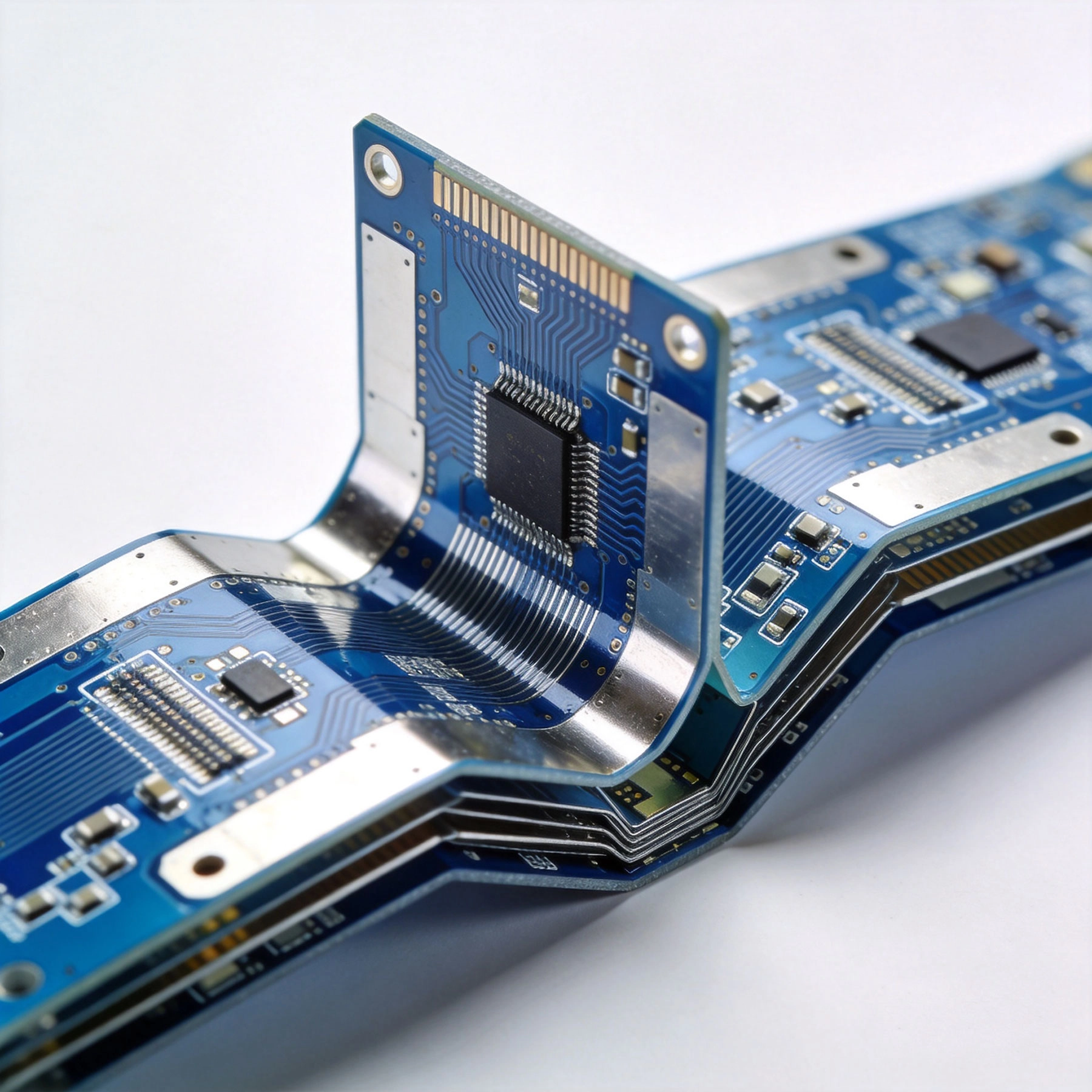
As electronic products shrink, add features, and demand greater reliability, traditional rigid circuit boards reach their practical limits. Consumer wearables must fold to fit wrists while maintaining connectivity. Medical devices need to navigate tight anatomical spaces. Aerospace systems require electronics that withstand extreme vibration without connector failures. These demands drive adoption of advanced interconnect technologies: rigid-flex and HDI boards.
Rigid-flex circuits combine rigid substrate sections with flexible circuit layers that bend, fold, or flex during use. HDI (High-Density Interconnect) boards pack more functionality into smaller areas through microvias, fine lines, and advanced substrate materials. Together, these technologies enable product designs that simply aren't possible with conventional rigid PCBs alone.
But manufacturing these advanced boards presents significant challenges. Design rules become more restrictive. Processing windows narrow. Quality verification requires more sophisticated techniques. Finding a manufacturing partner with true turnkey capabilities for rigid-flex and HDI technology can feel overwhelming.
This article explores what turnkey Pcb Manufacturing for rigid-flex and HDI boards involves, from design considerations through final assembly, helping you understand what to look for in a manufacturing partner.
Rigid-flex circuits integrate rigid PCB sections with flexible circuit layers into a single unified structure. Unlike assemblies where rigid boards connect through cables or connectors, rigid-flex designs embed the flex layers directly into the board stackup.
Rigid-flex circuits appear across industries:
High-Density Interconnect (HDI) PCBs push the boundaries of miniaturization through advanced manufacturing techniques that achieve finer features and higher connectivity density than conventional boards.
HDI technology achieves high density through:
Turnkey Pcb Manufacturing means a single partner handles everything from bare board fabrication through complete assembly and test. For complex rigid-flex and HDI boards, turnkey service offers significant advantages.
When rigid-flex or HDI boards require multiple suppliers—separate fabricators for bare boards, assemblers for SMT, and perhaps additional vendors for testing and inspection—each handoff creates risk:
Turnkey service consolidates responsibility. One partner owns the entire process, eliminating finger-pointing and accelerating issue resolution.
When the same team fabricates your boards and assembles them, they understand both challenges. This integration enables:
Working with one vendor for all PCB needs simplifies communication:
Successful rigid-flex manufacturing begins with thoughtful design. Understanding manufacturing constraints helps designers create producible boards.
Flexible circuit sections require specific design approaches:
Rigid-flex stackups combine rigid and flexible materials strategically:
Components typically mount only on rigid sections. Design considerations include:
HDI boards require careful attention to manufacturing capabilities during design. The tighter tolerances leave less margin for error.
Microvia technology drives HDI capabilities:
HDI line geometries require tight manufacturing control:
HDI substrates must meet multiple requirements:
Rigid-flex and HDI manufacturing present unique challenges that experienced fabricators learn to manage effectively.
Material Handling
Flexible materials require special handling throughout production. They must remain flat during processing yet flex without damage. Temperature and humidity control in processing areas becomes critical.
Registration
Achieving accurate alignment between rigid and flex sections demands precise registration systems. Variations in material behavior during lamination create challenges that conventional rigid board processing doesn't face.
Coverlay Processing
Applying and curing coverlay over flexible substrates without causing distortion requires specialized techniques and equipment.
Via Formation
Laser drilling of microvias requires precise control of energy delivery, pulse duration, and multiple hits. The dielectric material must respond consistently to laser ablation.
Copper Deposition
Microvia plating requires specialized chemistry and process control to achieve void-free coverage in high aspect ratio features.
Planarization
Building up multiple HDI layers requires careful management of surface planarity to ensure reliable component mounting on outer layers.
Verifying quality in rigid-flex and HDI boards requires more than standard inspection techniques.
Advanced boards require comprehensive documentation:
Not all PCB manufacturers have the capability or experience to handle rigid-flex and HDI production reliably. Here's what to evaluate.
Equipment
Experience
Quality Systems
For true turnkey capability, your partner should offer:
Rigid-flex and HDI boards cost more than equivalent conventional designs. Understanding the cost drivers helps set realistic expectations.
When your product design calls for rigid-flex or HDI technology, early engagement with your manufacturing partner pays dividends.
Before finalizing your design:
Reputable manufacturers offer formal design reviews:
For new designs:
Rigid-flex and HDI boards enable product designs that conventional PCB technology cannot achieve. Their advantages in size, weight, reliability, and performance make them essential for demanding applications across industries.
But these advantages come with manufacturing complexity. Success requires a manufacturing partner with true capability—not just equipment, but experienced engineers who understand the challenges and know how to address them. Turnkey service simplifies the Supply Chain and consolidates responsibility with a single capable partner.
When evaluating manufacturing options, look beyond initial pricing to consider capability, experience, quality systems, and the partner's commitment to your success. The right manufacturing relationship extends beyond individual orders to become a strategic asset supporting your product development.
Whether your application demands the space savings of HDI technology, the mechanical flexibility of rigid-flex construction, or both combined, investing time in finding the right manufacturing partner pays dividends throughout your product lifecycle.
Rigid-flex boards combine rigid substrate sections with flexible circuit layers that bend during use. HDI (High-Density Interconnect) boards achieve higher connectivity density through microvias and fine line geometries. These are separate technologies that can be combined—HDI layers can exist within rigid sections of a rigid-flex board.
True HDI capability starts with microvia formation (typically 0.15mm diameter or smaller) and any-layer or stacked via structures. Entry-level HDI might support 1-3 stacked microvia layers, while advanced HDI enables any-layer interconnect with multiple buildup layers.
Yes, HDI features can be incorporated into the rigid sections of rigid-flex boards. Microvias and fine lines work well in rigid layers, while the flexible sections use standard flex design rules. This combination enables high-density components in rigid regions while maintaining flexibility where needed.
Certification requirements depend on your application. Aerospace typically requires AS9100. Automotive needs Iatf 16949. Medical devices often require Iso 13485 or specific FDA compliance. ISO 9001 provides a baseline quality management standard for general electronics.
Cost reduction strategies include: specifying only necessary capabilities (not more advanced than needed), using standard material sets, optimizing board dimensions for panel efficiency, limiting the number of unique drill sizes, and building volume to spread setup costs. Early engagement with your manufacturer often reveals cost-saving opportunities.
Turnkey PCB Manufacturing: Ensuring Environmental Compliance (RoHS/REACH)September/07/2026
Cost-Effective Turnkey PCB Assembly Strategies for Smart Home DevicesAugust/06/2026
Turnkey PCB Manufacturing: Integrating Fabrication and Assembly SeamlesslyMay/26/2026
A Step-by-Step Walkthrough of the Turnkey PCB Manufacturing ProcessJune/09/2026
Best Turnkey PCB Assembly for Telecom 5G Infrastructure and Base StationsJune/26/2026
Best Turnkey PCB Assembly for Complex Multilayer Boards: What to Look ForSeptember/23/2026

Overcoming the High Cost Challenges of Low Volume Turnkey PCBAJune/11/2026
Advanced Turnkey SMT Assembly Techniques for High-Density InterconnectsMay/26/2026